
· 7 min read
Turn the heating down without feeling cold: the tips that actually work
Lower the thermostat without shivering: perceived temperature, draughts, humidity and what to wear indoors. The tips that work and the ones that don't.
- energy saving tips
- winter
- how to keep warm at home
- lower heating bills
Heating your home less without feeling cold is perfectly possible, and it almost never comes down to the thermostat alone. Three levers do most of the work: getting rid of draughts, raising the perceived temperature by tackling cold surfaces and humidity, and dressing properly indoors. The gain is far from trivial. According to ADEME, France's energy and environment agency, lowering the set temperature by just one degree cuts heating consumption by around 7%. Here's what really works, and what's just a myth.
Why heating is the only cost that really counts
We waste an incredible amount of time unplugging chargers. It's commendable, but it's the wrong order of magnitude. Heating alone accounts for around 66% of a French household's energy consumption, again according to ADEME. Hot water comes a long way behind, and all the electrical appliances put together further back still.
In practical terms, an hour spent draught-proofing a window pays off more than a month of hunting down appliances on standby. The order of effort is clear: first the set temperature, then air leaks, and only then everything else.
Another, less obvious consequence: unoccupied rooms are expensive. A study heated to 20 °C while you're in the living room is a radiator working for nobody, twelve hours a day.
What temperature to aim for, room by room?
French regulations set a clear limit. Article R241-26 of the French Energy Code, available on Legifrance (the official French legal database), provides that the average temperature in homes should not exceed 19 °C. It isn't a comfort recommendation, it's a regulatory ceiling that plenty of homes exceed without realising.
The floor, on the other hand, is about health. The World Health Organization sets 18 °C as the minimum indoor temperature that protects a healthy adult. Below that, respiratory and cardiovascular risks increase, especially with prolonged exposure.
Between those two limits, a simple setting works for most homes:
- Occupied living areas: 19 °C.
- Bedrooms: 17 °C, and your sleep is even better for it.
- Bathroom: 19 °C, turned up briefly when you shower.
- Unoccupied rooms: 16 °C, no lower, to avoid condensation.
One important exception: these benchmarks don't apply to a home where a baby, an older person or someone who is ill lives. In those cases, thermal comfort is a health issue, not a question of savings.
Perceived temperature isn't what the thermostat says
This is the point everyone misses. Your body doesn't sense the temperature of the air; it senses the balance between the heat it produces and the heat it loses. And it loses heat in four ways: by conduction, by convection, by evaporation, and by radiation towards the cold surfaces around it.
That last mechanism is the forgotten one. Sitting a metre from a picture window whose surface is at 12 °C, your body is constantly radiating heat towards it. The air may well read 20 °C, but you'll feel cold on the window side. Heating engineers talk about operative temperature, roughly the average of the air temperature and the temperature of the surrounding surfaces.
Hence three very cost-effective actions:
Deal with cold surfaces
A thick curtain drawn at nightfall in front of a window changes how the whole room feels. The same goes for a rug on a tiled floor, or a reflective panel slipped behind a radiator fixed to an uninsulated wall. None of these directly reduces consumption: they let you stay comfortable one degree lower, which amounts to the same thing.
Stop the air movement
A trickle of cold air at 0.3 m/s costs you the equivalent of one to two degrees of perceived warmth. Gaps under doors, roller-shutter boxes, sockets on outside walls, loft hatches: these are the usual suspects. A candle or a sheet of paper is enough to track them down in ten minutes.
A useful clarification: this isn't about blocking air vents. They're essential, and covering them creates damp, which makes you feel colder. You deal with unwanted leaks, not with deliberate ventilation.
Keep humidity in check
Air that's too humid makes you feel cold, because moisture speeds up heat exchange and loads the walls with damp. Air that's too dry is irritating. The comfortable range is around 40 to 60% relative humidity. Airing for five to ten minutes twice a day, windows wide open and radiators off, costs very little heat and dries the air effectively.
The opposite reflex, keeping the windows tightly shut all winter, is counterproductive: you end up heating air saturated with moisture, which takes longer to warm up and feels less pleasant.
Dressing warmly indoors, the most underrated lever
Here's the most cost-effective tip on the list, and the one nobody talks about seriously. Mountaineers know the principle: it's the layers of still air trapped between your clothes that insulate, not the clothes themselves. Three thin layers keep you warmer than one big jumper of the same total thickness.
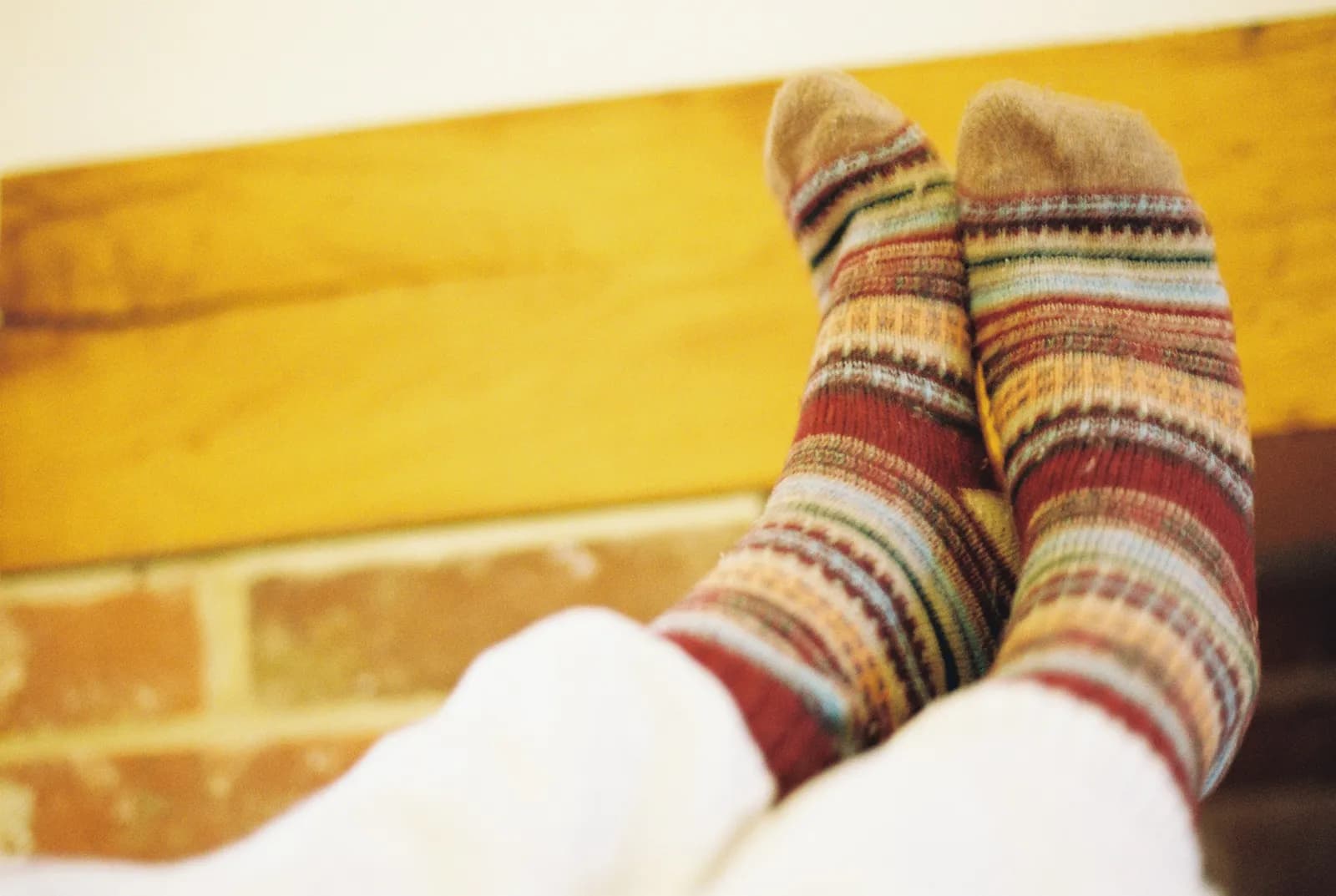
Your extremities deserve special attention. Feet, hands and head account for a large share of heat loss, and they're also the areas where feeling cold triggers the "I'll just turn the heating up" reflex. Decent slippers and a pair of thick socks often solve the problem of a room at 19 °C on their own.
The fabric matters as much as the thickness. A brushed, lofty fabric holds a lot of air; a dense, flat one very little. And the cut matters just as much: a tight garment squashes the insulating layer of air and cancels out the benefit. A roomy indoor onesie in thick flannel, like our hooded Monster Pyjamas, combines all three advantages: it covers your torso with no gap at the waist, it's loose, and the hood takes care of your neck and head in one go.
One practical detail makes all the difference: your indoor outfit needs to go on in fifteen seconds and be comfortable sitting down. A throw slips off, a coat is stifling, a big jumper leaves your lower back exposed as soon as you settle onto the sofa. What works is what you actually keep on.
The tips that are useless, or nearly
A few stubborn beliefs deserve to be put away for good.
Switching the heating off completely at night or during the day. In a moderately insulated home, warming it back up uses more than you saved, and the cooled walls take hours to warm up again. Turning it down by 2 or 3 °C, yes. Switching it off, rarely.
Using an electric heater to "top up". It turns one kilowatt-hour of electricity into one kilowatt-hour of heat, with no bonus. Used occasionally in a single room, it can make sense. Used all the time, it pushes up the bill.
Turning the thermostat right up to heat the room faster. A radiator doesn't heat faster because the setting is higher, it simply heats for longer. The only thing you gain is forgetting to turn it back down.
Turning off every radiator in unoccupied rooms. The idea is good, but the execution needs nuance: below 16 °C, condensation forms on cold walls and the damp migrates to neighbouring rooms. Turn them down, yes; off, no.
The one-week plan
| Day | Action | Effort |
|---|---|---|
| 1 | Set living areas to 19 °C and bedrooms to 17 °C | 10 min |
| 2 | Track down draughts (under doors, shutters, sockets) | 1 hour |
| 3 | Put up thick curtains and lay rugs in the coldest rooms | 1 hour |
| 4 | Check the humidity and start airing twice a day for 5 minutes | 15 min |
| 5 | Bleed the radiators and clear any that are blocked | 30 min |
| 6 | Put together your indoor outfit: slippers, socks, roomy onesie | 20 min |
| 7 | Reprogramme the thermostat around the times you're actually home | 30 min |
None of these actions requires building work or a big investment. Taken together, they let you live comfortably two degrees lower than last winter, which works out at around 14% less heating consumption based on ADEME's ratio. And if home really does become the place where you stay put, you might as well make the most of it: our guide to the perfect cosy Sunday has a few ideas for spending an afternoon at 19 °C without ever thinking about it.
Cover photo: Barney Goodman / Unsplash